Action Roadmap
Your SCEA / REA If-Then Roadmap
Single Choice Early Action (SCEA) and Restrictive Early Action (REA) decisions usually arrive in mid-December. Whatever the answer, you have only a few weeks before the next set of deadlines. This roadmap lays out what to do in each case so you are not making plans in a hurry over winter break.
The timeline at a glance
- November 1: Most SCEA and REA applications are due.
- Mid-December: Early results are released: admitted, deferred, or denied.
- Early January: Most Regular Decision and Early Decision II (ED II) deadlines fall in the first two weeks of January.
- February: Counselors send mid-year grade reports. Deferred applicants can send updates.
- Late March to early April: Regular Decision results arrive.
- May 1: National Candidates Reply Date, the usual deadline to commit to one college.
If you are accepted
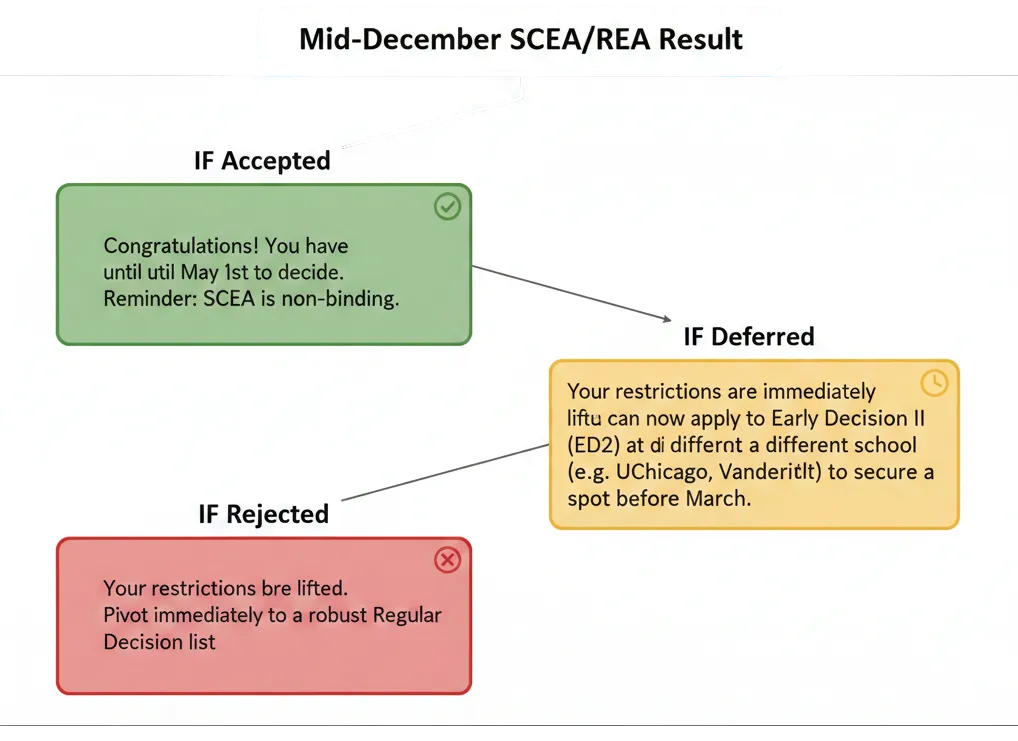
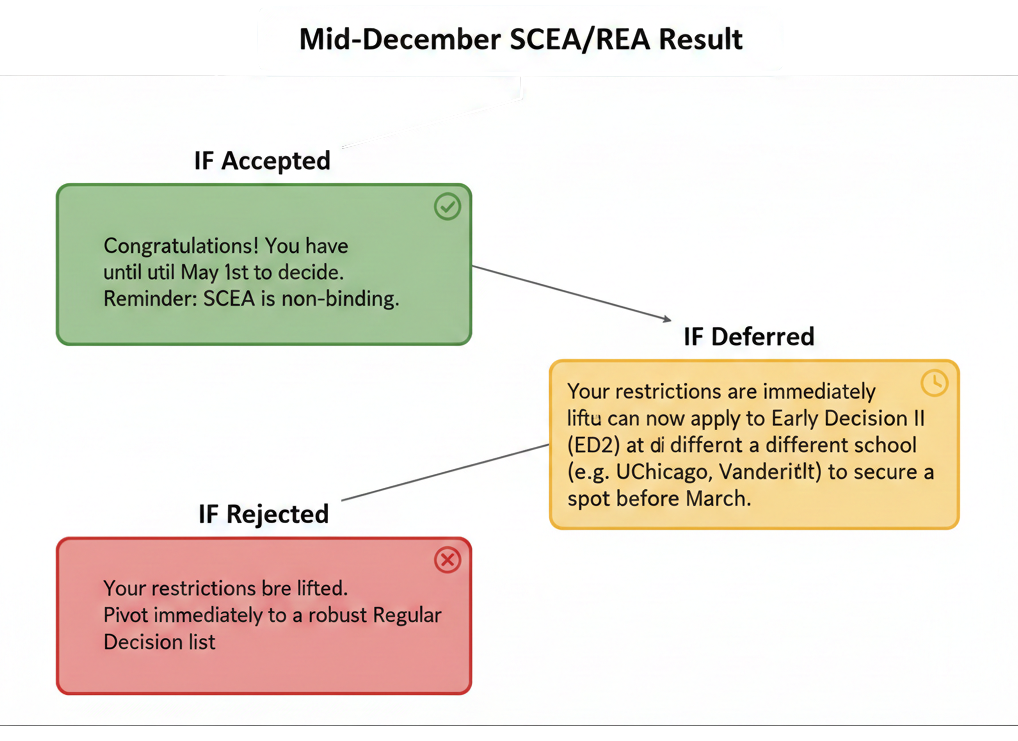
Congratulations. SCEA and REA are non-binding, so you are not required to enroll. You normally have until May 1 to decide.
- Review your financial aid offer. If cost matters, you may still want to apply Regular Decision elsewhere so you can compare packages in the spring.
- Trim your list. If you are certain this is your first choice, you can withdraw pending applications and skip applications you have not submitted yet. That saves you work and frees up spots for other students.
- Keep your grades up. Every admission is conditional on finishing senior year in good standing. A sharp drop in grades can put an offer at risk.
If you are deferred
A deferral moves your application into the Regular Decision pool, where it will be read again. The early-application restriction ends once you get your result, so you are free to apply to other early programs.
- Consider Early Decision II. If another school has become your clear first choice, an ED II application (for example to UChicago or Vanderbilt) can get you a binding answer by mid-February. Only do this if you would attend if admitted.
- Send a Letter of Continued Interest if the school accepts one. Some colleges welcome a short update. Others ask deferred applicants not to send extra material. Read the deferral letter carefully, and see our guide to writing a LOCI.
- Make your mid-year grades count. The mid-year report is often the most important new information the committee sees.
- Finish your Regular Decision list. Treat the deferral as a maybe and submit strong applications elsewhere by the January deadlines.
If you are denied
A denial in the early round is final for this admissions cycle, but your early-application restrictions are lifted right away.
- Turn to your Regular Decision list right away. Use the essays you already wrote as a starting point for January supplements.
- Look at ED II. As with a deferral, ED II is open to you if one school is now your clear first choice.
- Check your balance. Make sure your list includes schools where your profile is well within the typical range.
The roadmap as a chart
Save or print this chart to keep the plan in front of you through December and January.
Policies differ by school and change from year to year. Always confirm deadlines and early-application rules on each college's official admissions site, or run your list through our compatibility checker.